
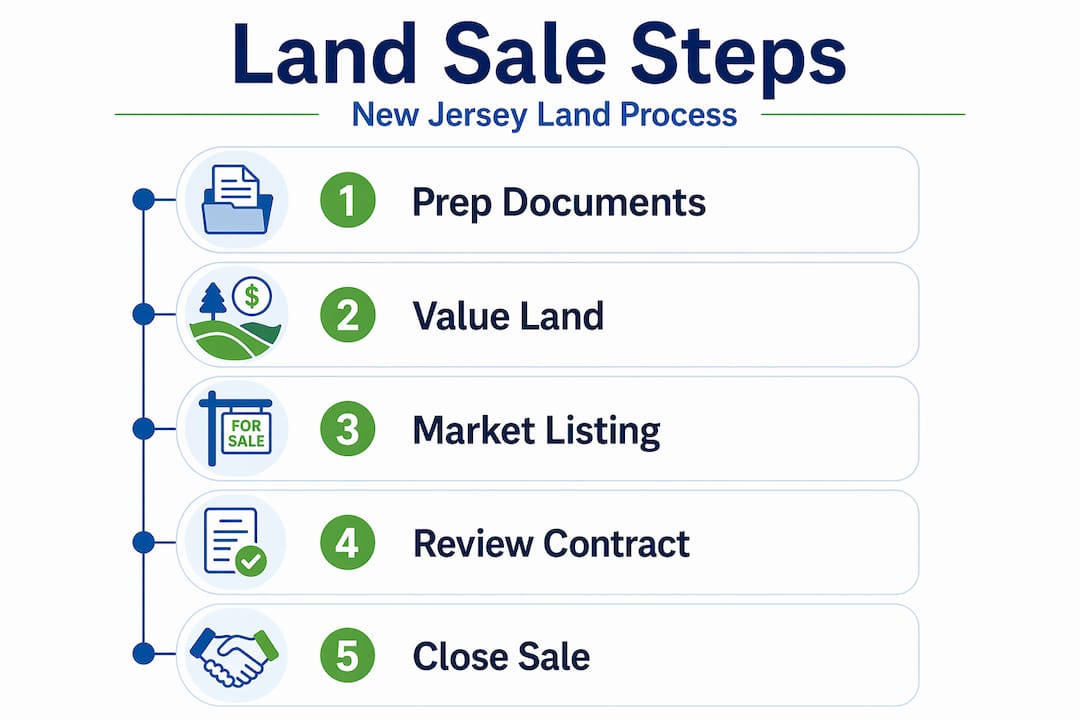
Selling land in New Jersey is not like selling a house. The moment you decide to prepare a land sale in New Jersey, you step into a process shaped by environmental regulations, zoning restrictions, mandatory legal review periods, and a buyer pool that thinks very differently from residential home buyers. Get it wrong and you face delayed closings, renegotiated prices, or post-sale legal disputes. Get it right and you walk away with maximum value on a clean timeline. This guide walks you through every critical stage, from legal groundwork to closing day, so you know exactly what to do and when.
Table of Contents
- Understanding New Jersey’s land sale legal framework
- Preparing your land documentation and valuation for sale
- Strategic marketing and finding the right buyer for your land
- Navigating attorney review, environmental rules, and transaction execution
- Verifying and closing your land sale successfully
- The overlooked realities of selling land in New Jersey
- How NJ Land Broker supports your land sale preparation and success
- Frequently asked questions
Key Takeaways
| Point | Details |
|---|---|
| Understand NJ attorney review | A mandatory 3-business-day period allows legal review and contract changes before deals are binding. |
| Prepare complete documentation | Gather deed, tax bills, surveys, and zoning records early to speed buyer confidence and closing. |
| Target cash buyers strategically | Marketing to local investors and cash buyers can reduce sale time and improve price outcomes. |
| Comply with disclosures and environmental rules | Full disclosure and awareness of 2026 NJDEP REAL amendments safeguard legal compliance and negotiation power. |
| Use expert brokers for better outcomes | Professional assistance can help navigate complex legal, environmental, and marketing challenges successfully. |
Understanding New Jersey’s land sale legal framework
Before you list a single acre, you need to understand the legal structure that governs every land transaction in this state. New Jersey is an attorney review state, which means that after a buyer and seller sign a contract, there is a mandatory 3-business-day attorney review period during which either party’s attorney can cancel the deal or propose changes. The contract is not legally binding until that window closes without cancellation.
This matters more for land than for homes. Land contracts often contain contingencies around zoning approvals, environmental studies, and development feasibility that require careful legal language. A standard residential boilerplate contract rarely covers these nuances. Hire an attorney who has handled raw land transactions, not just residential closings.
On the timeline side, closings typically run 45 to 60 days after contract execution for residential deals. Cash land sales can move faster, sometimes in 30 days or fewer, but only when documentation is already organized. Understanding the selling land requirements in NJ before you enter negotiations gives you a real advantage.
Key legal obligations every NJ land seller must know:
- Provide a completed Seller’s Property Condition Disclosure Statement before the buyer becomes contractually obligated
- Disclose known environmental conditions, encumbrances, or deed restrictions
- Comply with municipal requirements such as smoke detector certificates and certificate of occupancy inspections
- Confirm that all outstanding property taxes are current before closing
With the legal basics clear, let’s look at how landowners should prepare their property documentation and valuation.
Preparing your land documentation and valuation for sale
Think of your documentation package as your land’s resume. Buyers, especially developers and investors, will not make serious offers on a property with missing records. Incomplete documentation signals risk, and risk means lower offers or no offers at all.
Having deed, tax records, survey, and zoning details ready is essential for smooth buyer review and title work. Gather these before you market the property, not after you receive an offer.
Your land sales checklist for New Jersey documentation:
- Current deed showing ownership and any easements or restrictions
- Most recent property tax bill and confirmation of paid status
- Boundary survey (ideally within the last 5 years)
- Zoning certificate or letter from the municipality confirming current zoning classification
- Any prior environmental studies, wetlands delineations, or soil tests
- Utility availability confirmation (water, sewer, electric, gas)
- Any existing approvals, variances, or subdivision plans
Valuation is where many sellers leave money on the table. Land valuation is not simply a price per acre calculation. It requires analyzing comparable recent sales, factoring in highest and best use (the most profitable legal use of the property), access points, road frontage, and proximity to infrastructure. A parcel zoned for commercial use near a highway interchange is worth far more than its raw acreage suggests.
| Valuation factor | Why it matters | Impact on price |
|---|---|---|
| Zoning classification | Determines allowable development | High |
| Wetlands and floodplain coverage | Limits buildable area | High |
| Road frontage and access | Affects development feasibility | Medium to high |
| Utility availability | Reduces buyer development costs | Medium |
| Recent comparable sales | Sets market baseline | High |
| Existing approvals or permits | Reduces buyer risk and time | Very high |
Pro Tip: Request a free land valuation from a specialist before setting your asking price. Generic online estimators use residential data and routinely misprice land by 20 to 40 percent in either direction. You want a number grounded in actual land comps and local zoning context. You can also meet your NJ land expert to understand how local market conditions in counties like Monmouth, Burlington, and Mercer affect your specific parcel.
Document and valuation preparation is the backbone; now let’s examine how to market your land effectively to the right buyers.
Strategic marketing and finding the right buyer for your land
Land does not sell itself, and it does not sell to the same audience as homes. The land selling process in New Jersey requires you to think carefully about who your buyer actually is, because that determines where you market and how you price.

Marketing to cash buyers and local investors who understand NJ zoning and development rules speeds closings and produces better pricing outcomes. These buyers do not need mortgage contingencies, they move fast, and they understand what they are buying.
Your primary buyer targets in New Jersey:
- Local builders and residential developers looking for approved or approvable lots
- Adjacent landowners who want to expand their holdings
- Commercial developers scouting sites near Route 1, Route 9, or the Turnpike corridors
- Cash investors and “we buy land” companies (useful for quick sales, though typically below market)
- Conservation organizations and government agencies for environmentally sensitive parcels
How to reach them effectively:
- List on niche land platforms that attract investors and developers, not general real estate portals built for home buyers
- Post in local real estate investor groups on social media, particularly Facebook groups organized by county
- Contact adjacent property owners directly by mail, as they often pay premiums for land that expands their existing holdings
- Work with a land broker who maintains an active buyer network in your region
- Use targeted digital advertising focused on zip codes where developers and investors are active
Pricing for land requires a different mindset than pricing a home. Setting your ask at 90 to 95 percent of market value rather than padding it high actually generates more competitive interest and can trigger multiple offers. Overpriced land sits. It develops a reputation. And when you finally cut the price, buyers assume something is wrong with it.
Pro Tip: Always request proof of funds before sharing sensitive property documents or allowing site visits. Serious buyers provide this without hesitation. Anyone who resists is likely not a qualified buyer.
You can review land buyer profiles in NJ to understand who is actively purchasing in your market and what they prioritize in a deal.
Marketing well helps you lock in interested buyers; next, we cover navigating the legal and environmental hurdles during sale execution.
Navigating attorney review, environmental rules, and transaction execution
Once you have a buyer and a signed contract, the real work begins. The attorney review period is your first checkpoint. Use it. Do not assume the initial contract language protects your interests. Land contracts need specific provisions around environmental contingencies, feasibility periods, and what happens if zoning approvals fall through.
Environmental rules are where New Jersey land sales get genuinely complicated. The NJDEP REAL rule amendments adopted in January 2026 update standards for coastal areas, wetlands, floodplains, and stormwater management, with legacy provisions expiring July 20, 2026. This means that a parcel currently evaluated under older, more permissive standards may face stricter development requirements after that date. If your land has any wetlands or flood zone coverage, this deadline is not abstract. It directly affects what a buyer can build and therefore what they will pay.
| Regulatory area | What changed in 2026 REAL amendments | Seller impact |
|---|---|---|
| Coastal zone rules | Updated setback and buffer requirements | May reduce buildable area near coast |
| Wetlands delineation | Revised standards for freshwater wetlands | Could affect lot coverage calculations |
| Floodplain standards | Stricter stormwater and elevation rules | Affects feasibility for low-lying parcels |
| Legacy provisions | Expire July 20, 2026 | Time-sensitive window for some projects |
Disclosure obligations that apply even in cash deals:
- NJ law requires a signed Seller’s Property Condition Disclosure Statement before the buyer is contractually obligated, regardless of whether inspections are waived
- Known environmental contamination, underground storage tanks, or prior industrial use must be disclosed
- Deed restrictions, easements, and right-of-way agreements must be fully communicated
Pro Tip: Stay current on NJDEP environmental updates that affect your parcel’s development potential. Knowing whether your property falls under legacy or new REAL standards before negotiations begin gives you specific, factual talking points with buyers who are running their own feasibility numbers.
After navigating contracts and rules, the final step is ensuring a smooth closing with verification protocols.
Verifying and closing your land sale successfully
Closing a land sale in New Jersey involves more moving parts than most sellers expect. The typical NJ closing involves inspections, title search, tax forms, and document signing at the buyer’s attorney’s office, with the full process running 45 to 60 days from contract acceptance.
Critical closing tasks for NJ land sellers:
- Confirm smoke detector certificate and carbon monoxide detector compliance if any structures exist on the property
- Obtain a municipal certificate of occupancy if required by the local jurisdiction
- Ensure title is clear of any liens, judgments, or unresolved encumbrances before closing day
- Complete the required NJ tax withholding forms (GIT/REP series) or qualify for an exemption if you are a New Jersey resident seller
- Pre-sign closing documents if you cannot attend in person, which is common in land transactions
If you are selling to a government buyout program such as Blue Acres, the process has additional layers. Blue Acres buyouts require surveys, two closing inspections, and result in deed restrictions that preserve the land for flood storage and open space permanently. These are not quick closings. Budget extra time and understand that the deed restriction is irrevocable.
“A clean title, organized documents, and a seller who understands their obligations is the fastest path to closing. Every delay we see traces back to something that could have been prepared weeks earlier.”
| Closing task | Who handles it | Typical timing |
|---|---|---|
| Title search | Buyer’s title company | 2 to 3 weeks after contract |
| Municipal inspections | Seller arranges | Before closing date |
| Tax withholding forms | Seller completes | At or before closing |
| Document signing | Buyer’s attorney office | Closing day |
| Deed recording | Title company | Same day or next business day |
Review NJ government land buyout programs if you believe your parcel may qualify, particularly if it sits in a flood-prone area of counties like Monmouth or Burlington.
The overlooked realities of selling land in New Jersey
Here is what most sellers discover too late: the complexity of a New Jersey land sale does not shrink just because a buyer waves cash at you. In fact, cash offers sometimes create a false sense of security that leads to the most expensive mistakes.
Sellers who rush closings without full disclosure risk post-closing disputes even when inspections are waived. A buyer who waives their inspection contingency is not waiving their right to sue you for misrepresentation. Those are two very different things. Disclosure is not optional. It is not negotiable. And it does not disappear because the deal moves fast.
The second reality most sellers miss is that environmental regulatory timing is actually a negotiating tool, not just a compliance burden. The timing of legacy versus new REAL amendment standards can shift a parcel’s development feasibility significantly. A seller who understands that their property currently qualifies under more permissive legacy rules, and that those rules expire July 20, 2026, can use that window to create urgency with development-focused buyers. That is not manipulation. That is informed negotiation.
The sellers who get the best outcomes are the ones who treat preparation as a competitive advantage, not a bureaucratic checkbox. Organized documentation, accurate valuation, disclosure clarity, and regulatory awareness collectively signal to buyers that this is a seller who knows what they have. That confidence translates directly into stronger offers and fewer contingencies.
You can find more context on this approach through insider land broker tips that go deeper into how experienced brokers use regulatory and market knowledge to shift negotiating dynamics in the seller’s favor.
How NJ Land Broker supports your land sale preparation and success
Preparing a land sale in New Jersey on your own is possible. Doing it well, without missing a disclosure obligation, misreading a zoning classification, or underpricing a parcel with development potential, is where most sellers need a specialist.

At NJ Land Broker, Terrance Hardy provides free land valuations grounded in current market data, local zoning context, and the environmental factors that actually move land prices in counties like Monmouth, Burlington, Mercer, Gloucester, and Middlesex. Beyond valuation, the NJ Land Broker platform connects sellers with a targeted network of qualified cash buyers, developers, and investors who are actively acquiring land across New Jersey. From documentation review to closing coordination, the goal is simple: reduce your risk, increase your sale price, and close on a timeline that works for you. Explore active buyer network access to see who is purchasing land in your area right now.
Frequently asked questions
What is the attorney review period in New Jersey land sales?
It is a mandatory 3-business-day period after contract signing during which either party’s attorney can cancel or propose contract changes; the deal is not binding until this window closes without cancellation. For land sales with complex contingencies, this period is especially important to use fully.
How do the NJDEP REAL rule amendments affect my land sale in 2026?
They update environmental rules covering wetlands, floodplains, and stormwater management, with legacy provisions expiring July 20, 2026, which can alter development feasibility and therefore buyer pricing. Sellers with parcels near coastal zones or wetlands should understand which standard currently applies to their property.
Are all-cash offers without inspections completely risk-free for sellers?
No. NJ law still requires a signed Seller’s Property Condition Disclosure Statement before the buyer is contractually obligated, even when inspections are waived, and sellers remain liable for misrepresentation after closing.
What special steps apply if selling my land to a government buyout program like Blue Acres?
These sales involve property surveys, two closing inspections, and post-sale deed restrictions that permanently preserve the land for flood storage and open space, making them significantly more involved than standard private sales.