
You signed a purchase agreement and assumed the sale was locked in. Most New Jersey landowners make that exact mistake. Understanding what is a land sale timeline means recognizing that a signed contract is just the starting line, not the finish. From that first accepted offer through attorney review, environmental assessments, title clearance, and final deed recording, each phase has its own clock and its own risks. This guide breaks down every step of the land sale process so you can sell faster, avoid costly surprises, and walk away with the best possible outcome.
Table of Contents
-
Attorney review and its impact on the New Jersey land sale timeline
-
Parallel processes: inspections, financing, and title clearance in the sale timeline
-
Environmental due diligence: phases, regulations, and timeline effects in New Jersey
-
Tax prepayment and legal obligations affecting closing timelines in New Jersey land sales
-
Typical New Jersey land sale timeline stages and duration comparison
-
Partner with NJ Land Broker to navigate and speed up your land sale timeline
Key Takeaways
| Point | Details |
|---|---|
| Land sale timeline phases | The timeline spans from offer acceptance through attorney review, inspections, financing, title clearance, to closing. |
| Attorney review importance | New Jersey’s mandatory three-business-day attorney review delays contract finality and affects timing. |
| Concurrent processes | Inspections, financing, and title work run simultaneously, influencing the overall sale duration. |
| Environmental due diligence | Phase I and II ESAs plus NJDEP documentation can significantly extend closing timelines. |
| Title and tax clearance | Clearing liens and satisfying NJ tax prepayment requirements are critical to avoid closing delays. |
Understanding the land sale timeline basics in New Jersey
A land sale timeline is the full sequence of events between an accepted offer and the moment funds are disbursed and the deed is recorded in your name. It is not a single transaction. It is a series of overlapping workstreams, each with its own requirements, professionals, and deadlines.
Standard timelines from offer to closure vary significantly by deal type. Commercial land deals in New Jersey typically run 90 to 365 days. Residential land sales generally close in 30 to days 90 from the executed contract. Cash deals, where no lender is involved, can sometimes close in as little as two to three weeks when the title is clean and no environmental issues exist.
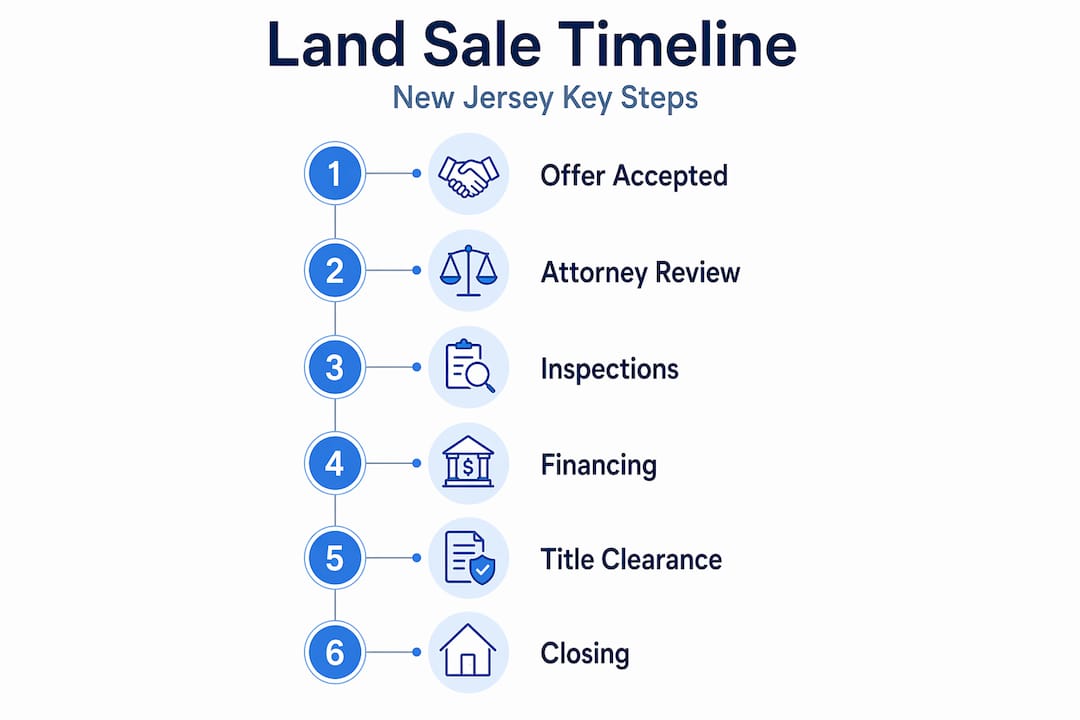
Here is how the selling land process in New Jersey breaks down at a high level:
-
Offer and acceptance — Buyer submits an offer; seller accepts or counters.
-
Attorney review period — A mandatory 3-business-day window unique to New Jersey where either party’s attorney can modify or cancel the contract.
-
Inspections — Property condition is assessed; findings may trigger renegotiation.
-
Financing and appraisal — Lender orders an appraisal and begins underwriting if the buyer is not paying cash.
-
Title clearance — Title company researches ownership history and resolves any liens or encumbrances.
-
Environmental due diligence — Phase I and potentially Phase II Environmental Site Assessments are completed.
-
Closing and deed recording — Final documents are signed, funds are transferred, and the deed is recorded.
Several of these steps run at the same time rather than one after another. That parallel structure is what makes the NJ closing timeline feel compressed even when individual steps take weeks.
Now that you know what a land sale timeline entails, let’s explore the critical early step that distinctly affects New Jersey land deals: the attorney review period.
Attorney review and its impact on the New Jersey land sale timeline
New Jersey is one of the few states where a signed real estate contract is not immediately binding. The contract is not truly binding until a mandatory 3-business-day attorney review period passes without cancellation or unresolved objections from either party’s attorney.
This period often shocks out-of-state sellers. As the NJ closing guide notes, sellers unfamiliar with New Jersey law sometimes treat signatures as final, only to find the deal renegotiated or canceled before the review window closes. That is a painful and avoidable surprise.
Here is what the attorney review period means practically for your timeline:
-
The clock on your sale officially starts after attorney review ends, not when you sign.
-
Either attorney can propose changes to price, contingencies, or contract language during this window.
-
If attorneys cannot agree on changes, either party can walk away with no penalty.
-
Renegotiations during attorney review can push back the start of inspections and financing.
-
The period runs on business days, so weekends and holidays do not count.
The attorney review effects on timelines are real and measurable. A deal that feels done on a Friday afternoon may not be legally binding until the following Wednesday at the earliest. Plan accordingly.
Pro Tip: Have your attorney ready before you sign. Sellers who engage their attorney in advance can often complete the review period faster, keeping downstream steps on schedule.
With the attorney review explained, let’s examine the parallel processes that run during the remainder of the timeline to prepare for a smooth closing, including inspections, financing, and title work.
Parallel processes: inspections, financing, and title clearance in the sale timeline
Once attorney review ends, three major workstreams typically launch at the same time. Inspections, lender work, and title clearance all happen simultaneously, which is good news for your timeline but requires active coordination.

Inspections confirm the physical condition of the land. For vacant land, this often includes boundary surveys, wetlands delineation, and soil testing. If the inspection reveals issues, the buyer may request a price reduction or repairs, which can pause the timeline while parties negotiate.
Financing and appraisal run on the lender’s schedule, which is largely outside your control. The lender orders an appraisal to confirm the land’s value supports the loan amount, then begins underwriting. Delays here are common and can push the closing date back by days or weeks.
Title clearance is where many New Jersey land sales quietly stall. Title issues including liens can extend timelines significantly because title insurers will not issue policies until every lien is formally released and recorded. Unresolved tax liens, contractor liens, or judgment liens can derail a closing entirely.
Here is a quick comparison of how these parallel steps typically affect your timeline:
| Workstream | Typical duration | Common delay triggers |
|---|---|---|
| Property inspection | 1 to 2 weeks | Renegotiation after findings |
| Lender appraisal and underwriting | 2 to 4 weeks | Low appraisal, buyer credit issues |
| Title search and clearance | 1 to 3 weeks | Unresolved liens, clouded title |
| Environmental assessment (Phase I) | 2 to 4 weeks | Site history, prior industrial use |
Pro Tip: Order a preliminary title search before listing your land. Clearing title issues early removes one of the most common reasons closings fall apart at the last minute, and it signals to buyers that you are a serious, prepared seller.
Understanding these concurrent steps prepares you to anticipate the environmental due diligence that frequently influences timelines, especially in New Jersey’s regulatory environment.
Environmental due diligence: phases, regulations, and timeline effects in New Jersey
New Jersey has some of the most rigorous environmental regulations in the country. For sellers of commercial or industrial land, and even some residential parcels with prior agricultural or industrial use, environmental due diligence is not optional.
The process typically unfolds in stages:
-
Phase I Environmental Site Assessment (ESA) — A records review and site inspection to identify recognized environmental conditions. No soil or water sampling is involved at this stage.
-
Phase II ESA — Triggered when Phase I identifies concerns. Involves actual soil and groundwater testing to confirm or rule out contamination.
-
Remediation — If contamination is confirmed, cleanup may be required before the property can transfer, adding months or even years to the timeline.
Environmental due diligence can require a Phase I ESA followed by a Phase II if concerns arise, adding real complexity and time to any deal. For New Jersey sellers, the regulatory layer goes further. Buyers and sellers may need NJDEP documentation such as No Further Action letters or Remedial Action Outcomes to satisfy state requirements and protect against future liability.
Key points every New Jersey land seller should know about environmental due diligence:
-
Phase I ESAs typically take two to four weeks to complete.
-
Phase II testing adds another two to six weeks minimum.
-
NJDEP review and approval of remediation plans can take months.
-
Properties with prior gas station, dry cleaning, or manufacturing use carry the highest risk.
-
Starting environmental assessments early, ideally before listing, gives you negotiating power and prevents closing delays.
Beyond due diligence and inspections, tax obligations like New Jersey’s seller tax prepayment requirements further shape the timeline as landowners prepare to close.
Tax prepayment and legal obligations affecting closing timelines in New Jersey land sales
If you are a nonresident seller, New Jersey requires you to prepay estimated gross income tax before or at the time of deed recording. This is not optional and missing it will stop your closing cold.
Nonresident sellers must remit estimated gross income tax prior to or at deed recording and provide required certification forms for closing to proceed. Specifically, you must submit the GIT/REP-1 form and obtain a GIT/REP-2 certification receipt, which your settlement agent needs at the closing table.
Here is what sellers need to manage on the tax side:
-
Confirm your residency status early. Nonresident obligations differ from resident sellers.
-
Work with a tax advisor to calculate your estimated gain and prepayment amount before closing day.
-
Provide the GIT/REP-2 receipt to your settlement agent in advance, not the morning of closing.
-
The settlement agent files the tax forms alongside the deed recording documents.
-
Failure to complete this step delays deed recording, which means funds are not disbursed.
Pro Tip: Coordinate with your settlement agent and a New Jersey tax professional at least two weeks before your scheduled closing. Tax prep paperwork that arrives late is one of the most preventable reasons closings get pushed back by days.
Typical New Jersey land sale timeline stages and duration comparison
Here is a realistic look at each stage of the land sale timeline, with duration ranges based on deal type and complexity.
| Stage | Residential land | Commercial/industrial land | Cash deal |
|---|---|---|---|
| Offer to executed contract | 1 to 5 days | 1 to 14 days | 1 to 5 days |
| Attorney review | 3 business days | 3 business days | 3 business days |
| Inspections | 1 to 2 weeks | 2 to 4 weeks | 1 to 2 weeks |
| Financing and appraisal | 2 to 4 weeks | 3 to 6 weeks | Not applicable |
| Title clearance | 1 to 3 weeks | 2 to 4 weeks | 1 to 2 weeks |
| Environmental due diligence | Varies | 2 to 12+ weeks | Varies |
| Tax prepayment and closing | 1 to 3 days | 1 to 5 days | 1 to 3 days |
| Total typical range | 45 to 60 days | 30 to 120+ days | 2 to 4 weeks |
New Jersey residential land sales generally range from 45 to 60 days from executed contract to closing. Commercial land deals vary more widely, typically 30 to 120 days depending on complexity.
A few factors that consistently shorten timelines:
-
Cash buyers with no financing contingency
-
Clean title with no liens or ownership disputes
-
No environmental concerns or prior industrial use
-
Seller has pre-ordered a survey and preliminary title report
-
All parties have experienced New Jersey land transaction attorneys
Land valuation insights also play a role. Properties priced accurately from the start attract stronger offers faster, reducing the back-and-forth that can add weeks before a contract is even signed.
What most land sellers miss about New Jersey sale timelines
Here is the honest truth that most generic real estate guides skip: the biggest timeline killers in New Jersey land sales are almost always self-inflicted.
Sellers who treat contracts as binding immediately instead of waiting on attorney review make downstream decisions based on a deal that does not legally exist yet. They cancel other inquiries, stop marketing, and sometimes make financial commitments before the review window has closed. When the deal falls apart during attorney review, they have lost time and leverage.
The second most common mistake is starting environmental due diligence too late. Environmental assessments should be treated as a parallel timeline starting early, not something you wait for the buyer to initiate. Sellers who commission a Phase I ESA before listing know exactly what they are working with. They can price accordingly, disclose proactively, and avoid the gut punch of a buyer walking away after a Phase II reveals contamination.
Title liens are the third silent killer. Sellers often have no idea a contractor lien or old tax lien exists until the title search surfaces it weeks into the deal. By then, the buyer is nervous, the lender is on hold, and the closing date has already slipped. Proactive title work, done before you list, turns a potential crisis into a footnote.
The sellers who close fastest and at the best prices treat the timeline as a project to manage, not a process to wait through. They run workstreams in parallel, engage expert insights on NJ timelines early, and never assume a signed contract means a done deal.
Partner with NJ Land Broker to navigate and speed up your land sale timeline
Selling land in New Jersey is not like selling a house. The zoning questions, environmental regulations, title complexities, and tax requirements require a specialist, not a generalist.

At NJ Land Broker, Terrance Hardy works exclusively with New Jersey landowners to move their residential, commercial, and industrial parcels from listing to closing with less friction and better outcomes. The process starts with a free land valuation that gives you an accurate, market-grounded price before you ever accept an offer. From there, the focus is on proactive title clearance, early environmental coordination, and experienced negotiation that keeps your timeline moving. If you are ready to sell your land in New Jersey with a professional who understands every phase of the process, or if you simply want to understand what a land broker can do for your specific situation, the conversation starts with one call.
Frequently asked questions
What is included in a typical New Jersey land sale timeline?
A typical NJ land sale timeline covers offer acceptance, the mandatory 3-business-day attorney review, concurrent inspections, financing, and title work through closing, ending with deed recording and fund disbursement. Environmental due diligence and tax prepayment obligations are additional steps that apply to many land transactions.
How long does the attorney review period last in New Jersey?
The attorney review period lasts exactly three business days, during which the contract is not binding and either party’s attorney can cancel or propose changes without penalty. Weekends and legal holidays do not count toward the three days.
Can environmental assessments delay my land sale closing?
Yes, significantly. Environmental due diligence like Phase I and II ESAs and required NJDEP documentation can extend closing timelines by weeks or months, especially if contamination is found and remediation is required before the property can legally transfer.
What happens if liens are not cleared before closing in New Jersey?
Unresolved liens create a clouded title, and title insurers require liens cleared before they will issue a policy. Without title insurance, most lenders will not fund the loan, which means the sale stalls or collapses entirely until the liens are formally released.
Are there tax requirements that affect the closing timeline for land sales in New Jersey?
Yes. Nonresident sellers must pay estimated gross income tax and provide GIT/REP certification forms to the settlement agent before or at deed recording. Missing this step delays deed recording and prevents funds from being disbursed at closing.
Recommended
-
NJ Land Insider Newsletter – NJ Land Broker
-
Understanding Land Brokers: What They Do and Why It Matters – NJ Land Broker